Sepia Saturday 82: Now Playing on Platform Number Two
The photographic prompt for this week's Sepia Saturday theme is an atmospheric shot from the Library of Congress collection of the interior of Chicago's Union Station, taken in 1943 by Jack Delano. My own contribution is from my personal collection, and the subjects might well have been spotted busking at Nottingham Railway Station half a century or so earlier.

Blind musicians, by H.L. Morel, Nottingham
Image © and collection of Brett Payne
Unfortunately there is no caption or inscription on this mounted paper print, so the identity of the subjects is at present unknown. From what I can remember of the eBay listing, it was purported to depict two well known blind musicians from Nottingham, but there was nothing more specific (and that could have been deduced from the photograph alone). Nor have I been able to discover anything further about this elderly couple, their dog and accordion. It is possible that the portrait was taken on behalf of and as a fundraising exercise for the Midland Institution of the Blind, set up in Nottingham in the mid-1840s, but that is really just conjecture on my part. I also note that it is very similar in character to a portrait of an old blind beggar taken by eminent Derby photographer W.W. Winter in the late 1890s or early 1900s, and still on display in the Winter's studio today.

The print is roughly similar in size to that of a cabinet card (102.5 x 150 mm), but pasted onto a printed and patterned brown card mount measuring 201 x 253 mm. The photographer's name and location, "H.L. Morel Nottingham" is blind stamped - no pun intended - beneath the lower right corner of the printed frame. This style of mount was in popular use in Edwardian times, and judging from the style of clothing and studio props, I estimate this portrait was taken between 1900 and 1910.

Carte de visite portrait of unidentified child, c.1892-1893
by H.L. Morel, Newcastle Chambers, Market Place, Nottingham
Henri Louis Morel (1858-1917) arrived in Nottingham in the early 1880s, having trained as a photographer with the prestigious London firm of Elliot & Fry. Initially he was employed at the studio of A.W. Cox, then being run by Cox's wife Ellen Elizabeth Cox. Morel married Sarah Elizabeth Munson at Nottingham in May 1883, and around 1885 he started to operate his own business from their home at 31 Bentinck Road, Hyson Green.

As the business became more successful, and perhaps attracted more influential patronage, he moved successively into new premises at 36 Goldsmith Street (1887), Newcastle Chambers, Angel Row (1892) and 126 Mansfield Road (1898).

Emptying and loading trams, Clifton Colliery, 1895
by H.L. Morel, Nottingham (Image ref. NTGM009567)
Image © North East Midland Photographic Record & courtesy of Picture the Past
Morel took commissions for work outside the studio too, as did many portrait photographers of the time. In April 1887, in conjunction with Henry Levy, he produced some group portraits as mementos of the visit of Lord and Lady Randolph Churchill to Nottingham.

Hard coal face spragged and timbered ready for holeing, Clifton Colliery
by H.L. Morel, Nottingham (Image ref. NTGM009559)
Image © North East Midland Photographic Record & courtesy of Picture the Past
In the early 1890s, he accompanied several sporting teams to events and successfully produced a number of popular group portraits. In 1895 he produced an important series of views showing underground working conditions at Clifton Colliery Nos. 1 and 2 Pits.
Henri Morel continued operating from Mansfield Road until at least 1910, and died at Nottingham in 1917.
References
Heathcote, Bernard V. & Heathcote, Pauline F. (2001) Pioneers of Photography in Nottinghamshire 1841-1910, Nottinghamshire County Council, 62p, ISBN 0902751387.

Blind musicians, by H.L. Morel, Nottingham
Image © and collection of Brett Payne
Unfortunately there is no caption or inscription on this mounted paper print, so the identity of the subjects is at present unknown. From what I can remember of the eBay listing, it was purported to depict two well known blind musicians from Nottingham, but there was nothing more specific (and that could have been deduced from the photograph alone). Nor have I been able to discover anything further about this elderly couple, their dog and accordion. It is possible that the portrait was taken on behalf of and as a fundraising exercise for the Midland Institution of the Blind, set up in Nottingham in the mid-1840s, but that is really just conjecture on my part. I also note that it is very similar in character to a portrait of an old blind beggar taken by eminent Derby photographer W.W. Winter in the late 1890s or early 1900s, and still on display in the Winter's studio today.
The print is roughly similar in size to that of a cabinet card (102.5 x 150 mm), but pasted onto a printed and patterned brown card mount measuring 201 x 253 mm. The photographer's name and location, "H.L. Morel Nottingham" is blind stamped - no pun intended - beneath the lower right corner of the printed frame. This style of mount was in popular use in Edwardian times, and judging from the style of clothing and studio props, I estimate this portrait was taken between 1900 and 1910.
Carte de visite portrait of unidentified child, c.1892-1893
by H.L. Morel, Newcastle Chambers, Market Place, Nottingham
Henri Louis Morel (1858-1917) arrived in Nottingham in the early 1880s, having trained as a photographer with the prestigious London firm of Elliot & Fry. Initially he was employed at the studio of A.W. Cox, then being run by Cox's wife Ellen Elizabeth Cox. Morel married Sarah Elizabeth Munson at Nottingham in May 1883, and around 1885 he started to operate his own business from their home at 31 Bentinck Road, Hyson Green.
As the business became more successful, and perhaps attracted more influential patronage, he moved successively into new premises at 36 Goldsmith Street (1887), Newcastle Chambers, Angel Row (1892) and 126 Mansfield Road (1898).

Emptying and loading trams, Clifton Colliery, 1895
by H.L. Morel, Nottingham (Image ref. NTGM009567)
Image © North East Midland Photographic Record & courtesy of Picture the Past
Morel took commissions for work outside the studio too, as did many portrait photographers of the time. In April 1887, in conjunction with Henry Levy, he produced some group portraits as mementos of the visit of Lord and Lady Randolph Churchill to Nottingham.
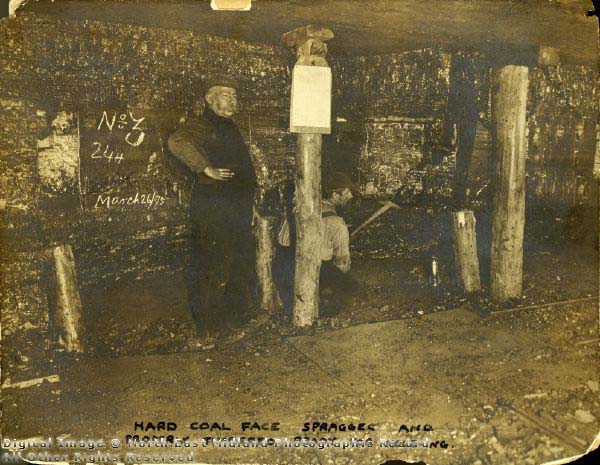
Hard coal face spragged and timbered ready for holeing, Clifton Colliery
by H.L. Morel, Nottingham (Image ref. NTGM009559)
Image © North East Midland Photographic Record & courtesy of Picture the Past
In the early 1890s, he accompanied several sporting teams to events and successfully produced a number of popular group portraits. In 1895 he produced an important series of views showing underground working conditions at Clifton Colliery Nos. 1 and 2 Pits.
Henri Morel continued operating from Mansfield Road until at least 1910, and died at Nottingham in 1917.
References
Heathcote, Bernard V. & Heathcote, Pauline F. (2001) Pioneers of Photography in Nottinghamshire 1841-1910, Nottinghamshire County Council, 62p, ISBN 0902751387.


Nhận xét
Đăng nhận xét